Not all businesses need the same payment setup.
A food vendor accepting M-Pesa at a market stall has different needs from a logistics company running daily bulk disbursements to fifty drivers. And both of them have different needs from a subscription software business billing customers automatically every month.
The mistake most businesses make is choosing a payment solution based on what they need right now, without thinking about what they will need in six months.
The Cost of Getting This Wrong
Switching payment providers is not like switching suppliers.
There is migration work. There are integrations to rebuild. There are customers who have saved their card details or payment preferences. There is staff retraining. There is downtime risk.
Getting the choice right the first time saves all of that.
The goal is to find a solution that fits where you are now, but does not trap you there.
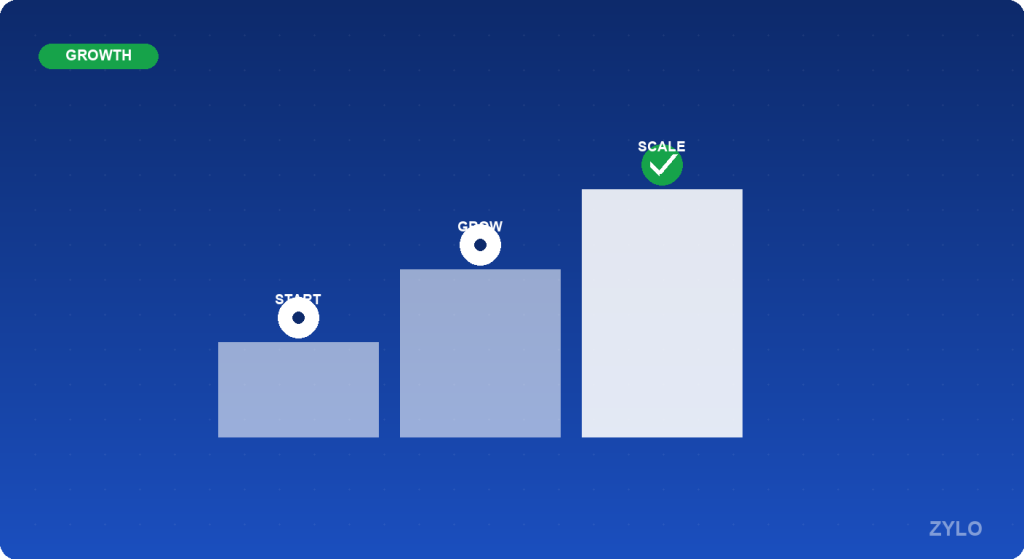
Early Stage: Getting the Basics Right
If your business is new or still finding its footing, simplicity is the priority.
You need to accept payments reliably across the methods your customers actually use. In Kenya, that almost always means M-Pesa. If you are serving a broader customer base, card acceptance matters too.
At this stage, you do not need a complex setup. You need something that works without requiring a technical team to manage it.
Look for clear pricing, quick onboarding, and a dashboard that gives you a basic view of your transactions without overwhelming you with features you are not ready to use.
Growth Stage: Volume and Efficiency Start to Matter
Once your business is processing a meaningful number of transactions, new pressures emerge.
Manual reconciliation becomes time-consuming. The person handling payments is now spending a significant portion of their time on administration rather than on anything that grows the business.
This is the stage where automation starts to pay off. Bulk payouts. Automated reporting. API integrations that connect your payment data to your accounting system.
You also start thinking about expansion. New markets. New customer types. Payment methods you have not needed before.
Your payment solution needs to grow with you, not require you to start again.
Scale: Reliability and Compliance Are Non-Negotiable
At a certain point, the questions shift from can we accept payments to how do we make sure nothing goes wrong.
Uptime becomes critical. A payment system that goes down during peak hours is not an inconvenience. It is a direct revenue impact.
Compliance matters more too. Enterprise clients and banking partners will ask questions about your payment infrastructure. PCI-DSS compliance, 3DS authentication, regulatory registration — these are no longer optional extras. They are the price of entry to larger contracts and more sophisticated partnerships.
At this stage, you need a provider with a proven track record and the documentation to back it up.
The Questions Worth Asking Before You Decide
What payment methods do my customers actually use, not just the ones I assume they use?
How many transactions am I processing now, and what does that number look like in a year?
Do I need to pay people out as well as collect from them?
Will I need to handle cross-border transactions?
What level of support will I need if something goes wrong?
How important is it that this integrates with my existing tools?
The answers to these questions will tell you more about what you need than any feature comparison ever will.
One More Thing
The right payment solution is not the one with the most features. It is the one that makes the most relevant things simple.
Complexity you do not need is not a selling point. It is noise.
Find the solution that fits your current stage, has room to grow, and makes your payment operations feel less like a burden and more like something that just works.
That is the goal. Everything else follows.